By Stu Shutt, Sentinel Homes
New Zealand homes have changed dramatically over the past few decades.
They’re bigger, warmer, more technologically advanced and designed to give everyone more independence and privacy. In many ways, that’s been a good thing. Families appreciate having more than one bathroom, better indoor-outdoor flow, warmer homes and spaces where people can get a bit of breathing room.
But I increasingly find myself wondering whether, in designing bigger and better houses, we may have unintentionally designed out some of the togetherness that used to define family life in New Zealand.
As a home builder, I spend a lot of time thinking about how homes shape behaviour. Not just how they look or what their resale value might be, but how people actually live inside them day to day.
Because homes aren’t neutral spaces. The way a house is designed absolutely influences how families interact.
Years ago, Kiwi homes were often smaller and simpler. Most families had one living room, one bathroom, one television, one family phone attached to the wall. You crossed paths constantly and spent time together without really having to think about it.
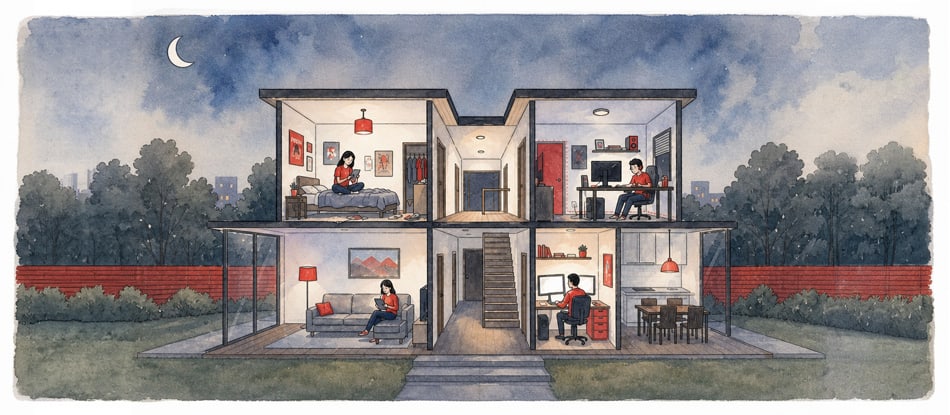
Today, many homes are designed around independence. Multiple living spaces, separate retreats, media rooms and oversized bedrooms with ensuites mean it’s entirely possible for a family of four to spend an entire evening under the same roof without properly interacting with each other.
Of course there are benefits to that. Privacy matters. Personal space matters. Teenagers probably don’t want to sit beside their parents every night watching Shortland Street anymore.
But I do think there’s a downside when retreat becomes the default setting in a home.
One person is gaming, someone else is scrolling social media, another family member is streaming Netflix in a second lounge while somebody works behind a closed study door. Everyone is technically home but not necessarily spending meaningful time together.
I’m not suggesting house design is responsible for family breakdowns or wider social challenges. Life is obviously much more complicated than that.
But I do think the way we design homes either encourages connection or discourages it, and that’s worth thinking about more carefully than we perhaps have in recent years.
Because if your house naturally pushes everyone into separate corners, at what point do we stop calling it a family home and start calling it shared accommodation with a mortgage?
New Zealand is having increasingly serious conversations about youth mental health, loneliness and belonging. Recent data from the Mental Health Foundation shows nearly one in four young New Zealanders aged 15–24 experienced high levels of psychological distress, while researchers and wellbeing experts continue pointing to connection, belonging and family support as important protective factors for young people.
I’m certainly not suggesting home design is the answer to complex social issues. But I do think the spaces we create either make family connection easier or harder. And in a world where everyone is increasingly distracted, busy and digitally connected elsewhere, that matters more than ever.
At Sentinel Homes, we often talk about building homes, not just houses. That philosophy sits behind our partnership with Parenting Place and our broader belief that the spaces we create genuinely influence family wellbeing.
For me, the kitchen is still one of the most important parts of a home. It’s where people naturally gather, where conversations happen without being forced and where a lot of everyday family life unfolds. Kids come in after school, people hover while dinner is being made and somehow those small moments become the glue of family life over time.
If I’m honest, many Kiwi families drifted away from that for a while. Eating dinner in front of the television became normal and convenience often replaced connection.
Shared spaces also create opportunities for younger children to participate in family life rather than simply consume it. Helping set the table, unpack groceries or stack the dishwasher might sound small, but those routines help build responsibility, contribution and connection over time.
I actually think we could learn a lot from many newer migrant cultures in New Zealand that still place a strong emphasis on shared food, mealtimes and gathering together at the end of the day. There’s something valuable in that sense of ritual and connection.
That’s why kitchens, dining areas and shared living zones matter so much in modern home design. They create natural opportunities for families to slow down and spend time together without it feeling forced.
The same applies to shared living spaces. A well-designed home should still allow for privacy and flexibility, but it should also make it easy for families to spend time together naturally rather than having to deliberately schedule it.
Interestingly, we’re seeing many returning Kiwis prioritise exactly this when they move home from overseas. They’re often coming back because they want a different environment to raise their children in. They want more connection, more balance and more of the lifestyle New Zealand has traditionally been known for.
The classic Kiwi lifestyle still carries enormous emotional value. People still want their kids outdoors, connected to community and growing up in homes that feel warm and social rather than isolated and transactional.
And I think that responsibility sits particularly strongly with builders operating in the heart of the New Zealand market, because we’re not talking about designing architectural showpieces for a handful of wealthy homeowners. We’re building the homes everyday Kiwi families will actually live in, raise children in and shape their lives around.
That doesn’t mean everyone suddenly needs smaller homes or fewer bathrooms. It simply means we should think more intentionally about how families move through a home and where natural connection points exist.
A home can still offer privacy and personal space while also encouraging family life to happen naturally rather than accidentally. Can parents cook dinner while still interacting with their kids? Does the layout encourage conversation? Is there a central place where people naturally gather at the end of the day?
Those questions matter just as much as benchtops, fixtures and square metreage.
Because in a world where everyone is increasingly distracted, busy and digitally connected elsewhere, the home is still one of the few places where genuine daily connection can happen consistently.
That’s something worth protecting, and in my view, it’s something worth designing for.
Let’s get together for a free, no-pressure meeting with one of our team, at your place or ours.
We can't wait to hear your ideas!



2.jpg)
2.jpg)